Calicivirus, pindone and 1080, side by side
Each of the three is controlled, and each by a different instrument.
| Tool | What it is | Who may use it | The instrument |
|---|---|---|---|
| Calicivirus (RHDV) | A calicivirus disease used in Australia to control wild populations of the European rabbit. | To acquire and use RHDV baits you must hold an AQF3 chemical accreditation or a Vertebrate Pesticide Induction Training accreditation, or work under the direct supervision of someone who does. First releases of rabbit diseases are organised by Local Land Services or DPIRD. | The EPA’s order for RHDV products. Products with an active strain are restricted chemical products, used only as the approved label or an APVMA permit directs. |
| Pindone | A poison laid on oats or carrots, which the NSW Government calls “the only poison for urban areas”. It has an antidote, vitamin K. | Pindone concentrate goes only to Authorised Control Officers, and only they make baits from it. Ready-made pindone bait products are for those officers and for people who meet the order’s criteria. The same accreditation as for calicivirus applies. | The Pesticide Control (Pindone Products) Order 2010, which authorises pindone products approved by the APVMA for use in NSW, subject to its conditions. |
| 1080 | Sodium fluoroacetate, used in rural settings. | An Authorised Control Officer must carry out a risk assessment when issuing it. Prepared and manufactured baits come only through authorised government agencies. | The 1080 order, which allows 1080 bait products for rabbits among four pests. DPIRD’s code adds that 1080 rabbit baiting runs only under a specific APVMA permit’s conditions, and rules it out where the risk to people and pets is unacceptably high, such as in urban and residential areas. The notice rules are in the notice on 1080 baiting. |
The pindone order explains why it covers products that are not restricted pesticides: the EPA chose to control pindone baits by authorising only the people listed in clause 9(2) of the order to use them. DPIRD’s code says pindone is justified only where 1080 cannot be used, close to urban areas, where the risk of accidental poisoning to people and pets is greatest. Because pindone acts slowly, a vet can give vitamin K1 as an effective antidote if a pet or farm animal is poisoned by accident.
Rabbit baiting with The Hills Shire
The council offers a free community rabbit baiting program twice a year, supplying both the unbaited and the baited carrots. Elsewhere on the same page, the council says pindone is lethal to dogs and cats and can make people ill if swallowed. Among the requirements on its page for taking part:
- you must live in The Hills Shire;
- the property you bait must be larger than 1,000 m²;
- you must notify your neighbours 3 days before pindone baiting;
- on the day of baiting, signs supplied by Local Land Services go up on your property and stay for at least 4 weeks after the last day of baiting.
That is a selection; the council’s page lists the rest. The 3 days’ notice to neighbours is the council’s requirement for its own program, as its page states it. It is not given here as a rule of NSW law.
The calicivirus release, and pet rabbits
The council takes part in an annual program to reduce feral rabbits across Northern Sydney, run with Greater Sydney Local Land Services. The strain is RHDV-K5, a virus already present in feral rabbits, which affects only rabbits; pet rabbits can be affected. The council encourages owners to have pet rabbits vaccinated by their vet before the yearly release into feral rabbits in public reserves.
The regional plan notes that “Since June 2022, a vaccine has been available to protect pet rabbits from 10 weeks of age against both RHDV1 and RHDV2.”
What lasts longer than poison
The NSW Government’s rabbit page is frank that baiting with 1080 or pindone brings numbers down fast, but the effect is short-lived unless it is combined with other methods. The page adds that landholders must commit to programs that run over many years.
- Warrens. Ripping breaks down warren structures and is vital for lasting control. When removing vegetation, stay within clearing laws and do not threaten endangered species.
- Harbour. The regional plan’s list of other rabbit harbour “includes blackberry, lantana, fallen logs, farm refuse, shipping containers, old machinery and rock piles”.
- Fencing. Rabbit-proof fencing can go around a property or an asset, and maintenance is essential.
- Shooting. Preferred in rural and some peri-urban areas, less so in urban ones, and used after numbers are first brought down.
- Trapping. Slow, catching a few at a time, with soft-jawed or cage traps. See the notice on trapping and the cruelty law.
- Fumigation. The regional plan says only experienced pest controllers working in pairs should do it, and that the chemicals are toxic to people, particularly in enclosed spaces.
Local Land Services gives technical advice, but coordinates group programs only where five or more adjoining properties take part.
How to tell rabbits are there
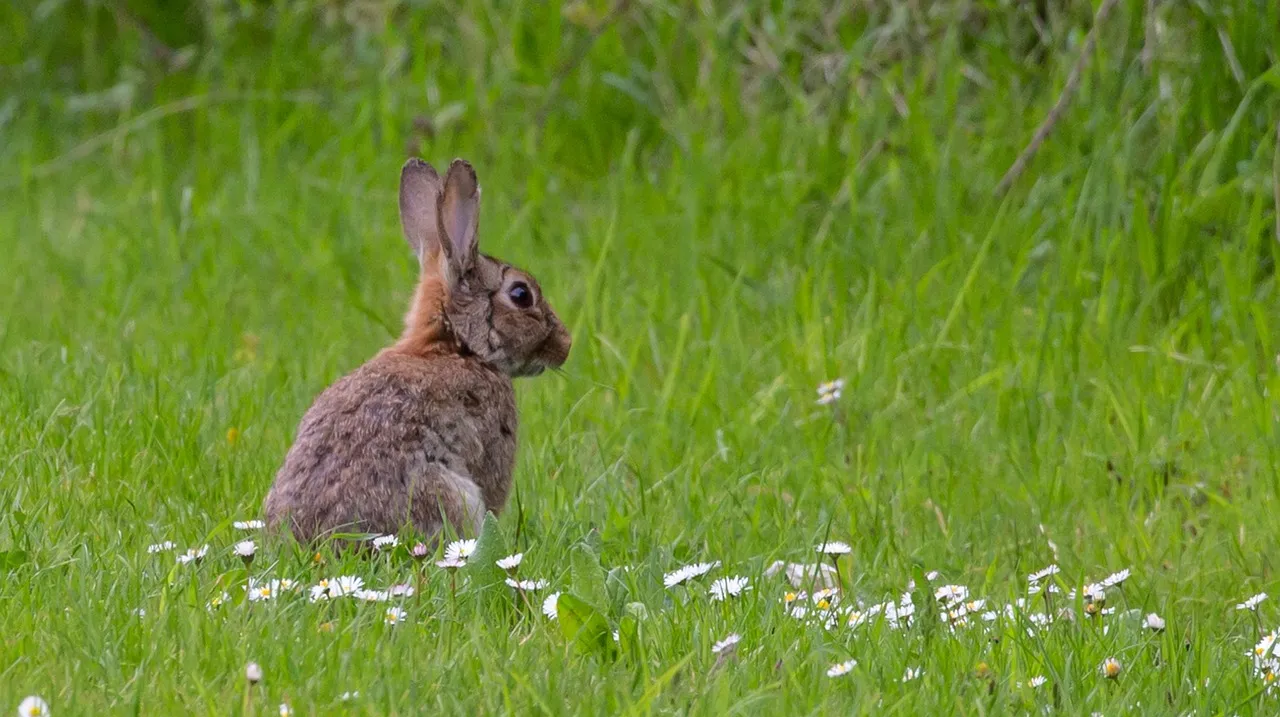
Rabbits can start breeding at four months old, and in good conditions have up to five or six litters a year. Among the first signs the NSW Government’s page describes: diggings and small narrow trenches around trees and plants; small to medium burrows with several entrances and droppings at them; and scats in round piles of small brown pellets. Report what you find on FeralScan, by photo on the website or through its app.